
Painting with Transparent Colors
Knowing the attributes of your paint puts you a step ahead as an artist. Being familiar with whether a pigment is transparent or opaque will help you in predicting how the paint will behave and give you a greater command over techniques such as glazing, layering, and color mixing.
Artist Spotlight: Adrian Arleo & Deborah Kapoor
This week we place the spotlight on two artists working with encaustic and form in imaginative new ways. Adrian Arleo's impressive ceramic sculptures make use of the natural surface quality of wax. She combines the figure and natural imagery to create a kind of emotional and poetic power. Deborah Kapoor's process-driven work uses contemporary cultural markers to explore narratives related to spaces the body inhabits. Encaustic is often the catalyst for adding dimension and texture into an array of absorbent materials in her work.
Demo Video: Encaustic Scraping
Scraping is a technique many artists use with encaustic to reveal the history of layers and color in their painting. This demo video was inspired by R&F Tier Artist Lorraine Glessner who writes a wonderful blog called Art Bite. The tools featured in this demo video include a pear-shaped loop tool, a razor blade, and a wax scraper from Sculpture House.
Removing "Skin" From Pigment Sticks
As your Pigment Sticks® begin to dry, a film of dried paint or "skin" will begin to cover areas exposed to oxygen. If you find a skin has formed on the surface of your stick, you can gently remove it with a paper towel or rag and Linseed oil, or the use of a razor blade. Below, you'll find the steps to remove this dried paint film and to maximize the workable paint within.
Painting With Opaque Colors
You will find in painting with Pigment Sticks® or encaustic that some colors are opaque while others are translucent. Opaque colors tend to be brighter and have a greater ability to hide underlying color and mark making. Translucent colors tend to be deeper and reveal the layer under it.
From The Collection: Abby Goldstein
R&F is fortunate to have four pieces by Abby Goldstein in our permanent collection. We reached out to her to learn more about the encaustic work she did from 2009 to 2013 and how it relates to her other bodies of work.
Encaustic: Basic Studio Setup
In this blog post we look at the basic requirements of setting up your space for success. We will cover - materials & tools, ventilation, electrical requirements, and design.
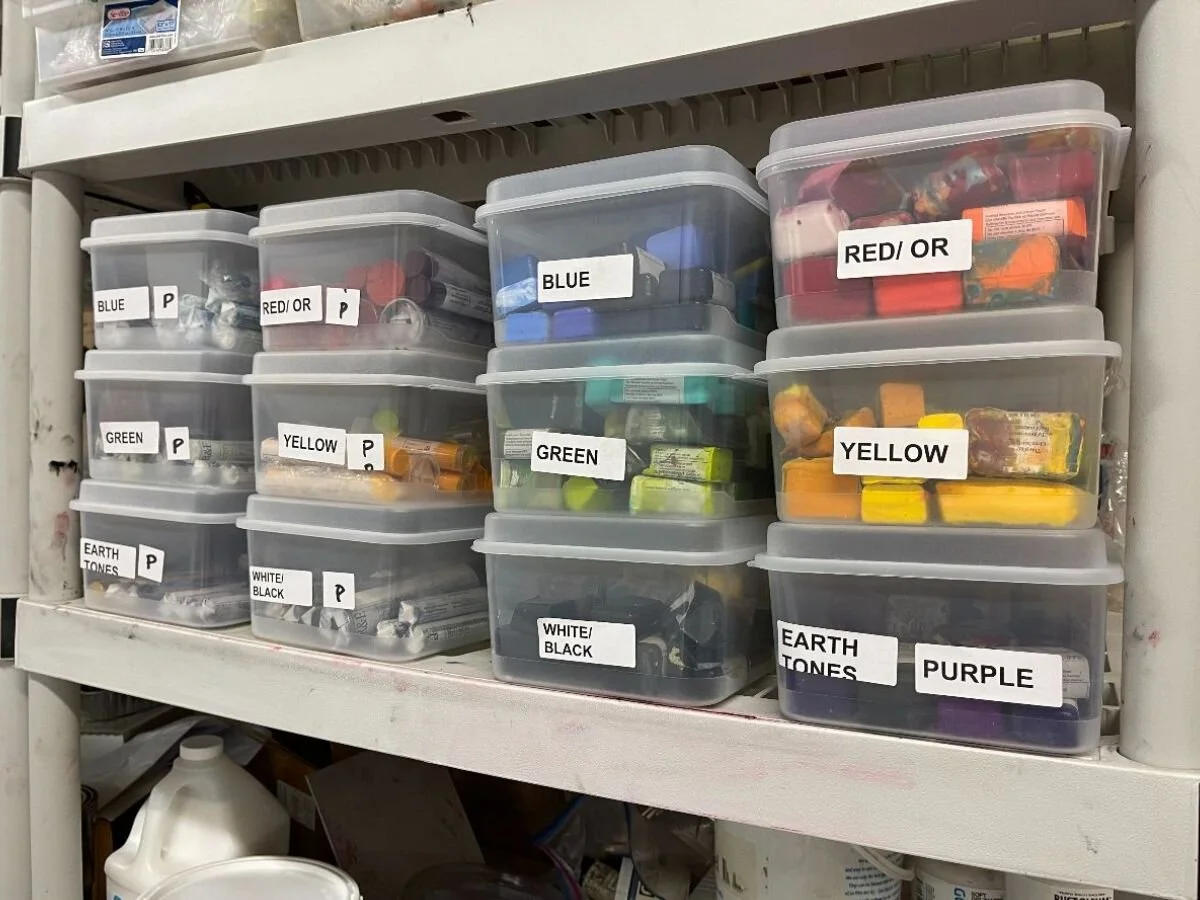
Encaustic: How To Store Your Paint
This week we revisit helpful ways to store paint in your studio, with a focus on encaustic. We'd like to begin by giving a quick shout-out to those who responded to our last newsletter with personal storage tips and tricks.
R&F Pigment Sticks®: How To Store Your Paint
We are often asked for the best way to store R&F paints. As with many of the technical questions we receive, there tends to be more than one correct answer depending on your needs. We checked in with the R&F Core Instructors to learn about some of the products (store-bought and custom-made) and methods they are using in their studios.
From The Collection: Marina Thompson
Artist Marina Thompson finds stimulation in “the pulse of color and the play of light and texture.” She describes her paintings as an effort to “generate depth, energy, and movement with illusions of volume, space, light, and time.” Marina might just have one of the most amusing pictures on the “About” tab of her website we’ve seen and we are thrilled to have her work Cross Purposes as part of the permanent collection at R&F.
Ask Richard: Achromatic Blacks, Chromatic Blacks & Chromatic Whites
Back by popular demand…another in our series of “Ask Richard” blog posts. We sat down (virtually, of course) with R&F founder Richard Frumess to learn a little bit more about the categories achromatic black, chromatic black, and chromatic white, and how we might apply these categories to our own painting practices.
From The Collection: Nancy Natale
Artist Nancy Natale’s work is richly complex and unique. Her pieces explore color, geometry, and juxtaposition, “jostling the grid and setting one thing against another,” and often utilize unconventional materials such as rubber from inner tubes and upcycled handbags. R&F is delighted to have Place In The Sun as part of our permanent collection. We reached out to Nancy this week to hear how the last year has affected her practice and what she is currently working on.
Encaustic & Sculpture: Pamela Blum, Anna Wagner-Ott, & Susan Stover
Ever the versatile material, encaustic can be modeled, carved, cast, and applied to absorbent materials to build sculptural forms. The wax sculptures of today are often created by applying encaustic to absorbent materials such as wood, fiber, bisque fired clay, and paper mache. We checked in with artists Pamela Blum, Anna Wagner-Ott, and Susan Stover to get familiar with their evolving individual approaches and the techniques they are using to sculpt with encaustic today.
Demo Video: How To Do A Pour
An encaustic pour offers you a quick and relatively easy way to get a smooth even surface. Our latest YouTube video demonstrates two ways to do pours - one that will create a thick surface and a pour-over that will create a flat, thinner surface. Check out the video link below and be sure to subscribe so you don’t miss any of our YouTube videos.
Painting The Landscape: Regina B. Quinn & Cherie Mittenthal
We continue our series on "Painting the Landscape" in conversation with artists Regina B. Quinn and Cherie Mittenthal. Their paintings share a common appreciation and close observation of the landscape they reside in. They capture the seasonal changes, weather changes, and events that shape land over time.
From The Collection: Don Maynard
Don Maynard lives and works in Kingston, Ontario. His art practice includes painting, sculpture, and multi-media installations. Previous public art works include Stand of Birch, Archive and Fallen Star for the City of Ottawa and Wave for the City of Toronto. Maynard shows nationally and internationally. He is the recipient of a Pollock-Krasner Foundation Grant and a Chalmers Fellowship. Previous solo exhibitions include Tidal Mass, and Franken Forest at the Agnes Etherington Art Centre in Kingston, and Franken Forest at the Robert McLaughlin Gallery in Oshawa.
From The Collection: Leigh Palmer
Leigh Palmer received a BFA in painting from the Rhode Island School of Design in 1966. He is the recipient of a MacDowell Colony Fellowship and has had numerous solo shows in New York, Massachusetts, and Connecticut. His paintings Interior with Three Pears and Striped Tablecloth with Two Apples, both oil on linen from 1983, are in the permanent collection of the Smithsonian American Art Museum (gifts of the Sara Roby Foundation), and his work is in multiple corporate and private collections, including the National Museum of American Art, The New School for Social Research, and American Bank and Trust.
Fascinating Geometry
We've been watching the many ways artists have explored geometry with our materials, which came to light while researching for our newsletter on encaustic inlay. We spoke with two artists, Joe Celli and Penny Dell, about the application of geometric ideas in their encaustic work. Penny visits our studio regularly and works with collaged geometric patterns, often on paper. Joe inlays a multitude of translucent geometric shapes to build a dimensional surface in an almost cathartic experience.
How To Clean A Brush: R&F Soy Wax
Our latest YouTube video is a demo on how to clean your encaustic paintbrushes using R&F soy wax. Artists ask us what soy wax is for all the time. In this brief video, we share a few tips and easy to follow steps to help you get started.
From The Collection: Joanne Mattera
Artist, author, and founder of the annual International Encaustic Conference, Joanne Mattera’s use of color is nuanced, rich, and deep. R&F is fortunate enough to have two paintings by Joanne in our permanent collection. In this conversation, we learned a bit more about Joanne’s relationship to color, the way she creates tension within her paintings, and how the element of surprise affects her work.